
Frequently Asked Questions and Supplemental Information
Frequently Asked Questions and Supplemental Information
Introduction
For some time, Shakhàn players have submitted questions to Telostic Corporation design staff regarding various aspects of the game, both on the mechanics of play and on the game setting (e.g. religions, history, geography and so on).In the past, it was our practice to amass these and then incorporate them into the next edition of the game rules, but as a 2001 CanGames edition of Shakhàn will not be published, it is appropriate to make the answers to these questions available via the Shakhàn Website.
If you have a question regarding Shakhàn, by all means send it to us at:
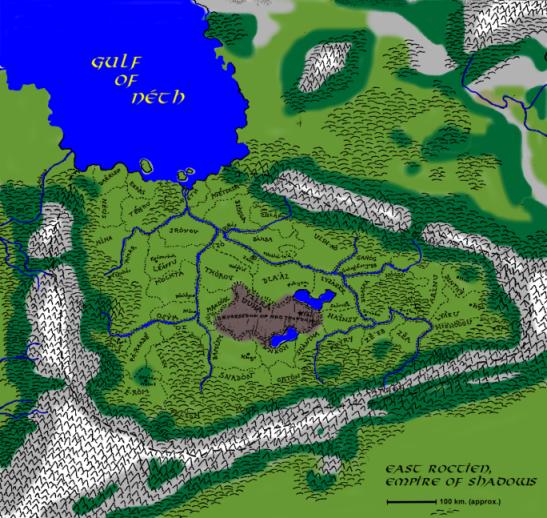
Fief map of the Empire of Shadows (as of summer 104 AU)
Q: Who really controls the Shadowed Empire? Does it have an "Emperor" like Roctien or Javertien? What is it like to live there?A: As far as is publicly known in all but the most well- (that is, supernaturally-) informed circles of northern Ushù'l as of the start date of play in standard Shakhàn (that is, 104 AU), East Roctien is officially governed by a "Dark Trinity" of the Temples of the Khùl-Nolgùn called the "Alliance of the Deepest Hour". This body is composed of elder clerics from the Temples of Væran Rssà-Urutàngk (responsible for the Army of Shadows as well as East Roctien's relatively small navy), Vìrya Hé-Enriath (Whose Temple runs the theocratic secret police; priestesses and priests of this ancient faith also seem to provide most of the Shadowed Empire's magical protections) and Væran Hnélo-Tràniss (Whose clerics control the secular secret police, the civil administration and most other functions that do not fall specifically within the jurisdictions of the other two Temples).
The senior governing council of the Alliance includes three of the highest-ranking Dark Paladins from the Temple of Væran Rssà-Urutàngk, three High Adepts from the Temple of Væran Hnélo-Tràniss and five of the most elder High Priest(ess)es of the Temple of mighty Vìrya Hé-Enriath. The Alliance council meets in secret on an irregular basis in the forbidden East Roctiennae religious capital of Yìl (yee-ILL) and all of its decisions are communicated to the public, where this is deemed necessary, by the civil arm of the Temple of Væran Hnélo-Tràniss. In some ways the Temple of great Vìrya Hé-Enriath seems to be "first among equals" in this relationship, but as Her mysterious religion does not especially value participation in mundane affairs, in practice the Temple of Væran Hnélo-Tràniss has much more control over the lives of ordinary citizens in East Roctien.
From time to time – the circumstances of this are unclear – the council also includes a few representatives from other Temples of the Khùl-Nolgùn or from faiths devoted to the demonic servitors of the Temples of the Khùl-Nolgùn. In particular, the High Adepts of the Temple of crimson-hued Væran Bssìro are sometimes present, but also occasionally are those of skulking Væran H'òngg-Hélé. Adherents of the Temple of Vìrya Yog-Ròthe, Goddess of the Frozen Hell, have never been seen at Alliance council meetings; whether this is because this faith deliberately stands aloof from affairs of state, or because icy Yog-Ròthe's Temple has been formally barred from attending, is unknown. Needless to say, there is no representation on the part of the more sinister "non-mainstream" religions, although discreet worship of the least dangerous of these is unofficially tolerated and can indeed be found in some of the more secluded regions of East Roctien.
Although – as stated in the original Shakhàn rule set – far and away the most powerful character in the Shadowed Empire is the feared and terrible Ròaon, it would be something of an oversimplification to call this sinister being an "Emperor" in the same sense as would, for example, be the case for the current rulers of Roctien or Javertien.
From what is publicly known about how East Roctien is governed, Ròaon takes virtually no part in any of the conventional affairs of state (for example, managing the budget, overseeing the bureaucracy and administering law, public speaking, controlling the army, and so on); his interests are purely "other-dimensional" and are consumed by battles he is fighting against others of his own kind. (Every so often, however, Vòrin Ròaon gets a bit of free time, which is why it is a very dangerous mistake to antagonize him.) He is never known to have attended a meeting of the Alliance of the Deepest Hour, but instead makes his wishes known to the elders of the Temple of Vìrya Hé-Enriath by some unspecified means.
So far as is known, none of his requests or demands have ever been refused, but this does not mean that Vòrin Ròaon has complete control over the Alliance, either; many of the members of the Alliance council are mighty magicians, in their own right, and together they might be able to stand up to even so puissant a being as "He Whose Name Is But Whispered".
Everyday life in the Shadowed Empire is similar to that found in other civilized areas, at least for the lower classes, with one notable exception: for obvious reasons, open worship of gentle Vìrya Fèftian-Ithé, the Lady of Fertility, is prohibited in East Roctien (doing so is theoretically a capital crime, although this rule is infrequently enforced). All citizens whose Clan is not officially pledged to a different religion are by default assumed by common law to be worshippers of cruel Væran Hnélo-Tràniss, and therefore are required to at least profess (however unenthusiastically) this faith and contribute tithes to it; this is, of course, one reason why Væran Hnélo-Tràniss' Temple has so much secular power within the Empire.
Q: Can a human and a member of an intelligent non-human species mate and produce offspring? Could you, for example, have a "half-Bènli" character?
A: This subject was touched upon briefly in the Shakhàn 2000 (and earlier) game manuals In general, and as a default game rule, cross-species breeding in Shakhàn can be considered to be such a rare and difficult occurance that it should be prohibited (by sane Referees, at least) for player-characters.
One of the main reasons that this policy was adopted in the standard Shakhàn rules was a very practical one: each of the Shakhàn player species has its own, unique characteristics, and considering the number of intelligent races that are already represented in the game set, writing sensible rules to deal with the literally hundreds of potential "half-Arda" or "one-quarter Nika'Khàdra" situations that might arise, would be a huge task, in no way commensurate to the relatively small playing value that would result.
On "real" Telostic, it's a much more complex subject than the standard game rules indicate. Leaving aside the usual societal prohibitions against this type of "unnatural" practice – these exist in almost all the Empires of northern Ushù'l – certain types of cross-species matings have, indeed, happened from time to time.
Probably the most common examples of this are couplings between humans and the Bènli; of all the intelligent species, these two races are the most closely related, genetically, and this is the only extra-racial pairing that is likely to produce offspring, with the child retaining all the racial characteristics of either its father or mother. However, the mixed blood is passed down to the next generation, so (for example) if an apparently Bènli female child is born to a human male and a Bènli female, and then the child subsequently becomes a parent herself, her own offspring may again appear to be either human or Bènli. As might be expected, this factor has caused many misunderstandings among human and Bènli inhabitants of northern Ushù'l over the ages, and has lead to some interesting paternity and clan-relationship disputes.
Amongst the other species, in most case the DNA factors involved are so different as to prohibit reproduction. Two partial exceptions and one large exception to this do exist, however.
The Arda and the Hàmyé are sufficiently genetically alike that they theoretically can mate and have children. The fertility rate here is almost as high as with the human / Bènli combination, but for unknown reasons, most such offspring die from internal organ failure shortly after reaching puberty.
Meanwhile, from time to time an especially perverse Ri'ìm has been known to have mated with a Hoyoté-Gò, but these pairings are almost always sterile; the very few offspring that this species combination has ever produced, have all either died in infancy or have grown up as mis-shapen "freaks", ostracized not just by the Ri'ìm and Hoyoté-Gò communities but by the rest of society as well. Similarly, it is theoretically possible for the Ri'ìm to mate with the Nika'Khàdra (as it is possible for the Nika'Khàdra to mate with, and produce offspring by, the Hoyoté-Gò); but in practice, the opportunities for this are extremely rare.
The most reliable way to produce an interspecies hybrid involves the magics of the perverse Temple of Væran/Vìrya Kikiri; this religion is known to engage in experimentation of this sort both for ritual reasons and, occasionally, on a paid or complementary basis for a favoured lay worshipper. The most experienced priests and priestesses devoted to grotesque Væran/Vìrya Kikiri are said to be able to force the production of offspring between almost any combination of dissimilar species (although, curiously enough, they cannot cure infertility among sapients who are trying to have children with others of their own species – for this, one must turn to the Temple of bounteous Vìrya Fèftian-Ithé), but for most Shakhàn players of ordinary means, the Temple of Væran/Vìrya Kikiri would be able to cause cross-species fertility among only beings of the approximate same body type (e.g. "humanoid", "quadruped humanoid", etc.). The price for one application of the appropriate spell is about 10,000 Ogròn in modern Rocto-Ardae currency, and the Temple of this perverse God(ess) Væran/Vìrya Kikiri may well require payment in kind as well, for example regular attendance at Temple orgies by any offspring so created.
Furthermore, if a cross-bred creature is particularly well-endowed in a physical sense, the Temple of Væran/Vìrya Kikiri may simply kidnap him / her / it at birth for permanent service in this strange religion's obscene rituals. Such an unfortunate being would have little opportunity to ever venture outside the walled confines of one of Væran/Vìrya Kikiri's temple complexes, and thus would be of little use in a normal Shakhàn campaign.
Q. The Watchers are neat. Can I roll one up to use as a player character?
A. The short answer is, "no".
The Khùl-Algrenàthi'i are really fixtures of the background environment of a Shakhàn campaign setting, in the same general manner as are the deities and demons, and like the latter they are exceedingly rare on "real" Telostic – most sapients on "real" Telostic would live out an entire lifetime without ever encountering a Watcher (although, conversely, most citizens of the populated regions of northern Ushù'l would definitely know of the legends surrounding the Khùl-Algrenàthi'i and their supposed exploits).
Furthermore, as is the case with any super-powered "legendary" Shakhàn character, a Referee allowing any but the most experienced Shakhàn players to manage one of the Khùl-Algrenàthi'i would quickly run up against the following problem.
To many real-life players, the survival or loss of a single character is of little or no importance (he or she can always just roll up another one, after all). The most common manifestation of this in a normal FRP environment is the exposure of fantasy characters to repeated, sometimes unnecessary risks in pursuit of whatever goal the players' party happens to have immediately in front of it. This is fine for an ordinary character (the loss of which makes little difference to the game's setting in Ushù'l), but on the other hand the Watchers, all the while few in number, must remain alive to guide the history of Telostic over eons. This would require a very special type of management on the part of a "live" player.
A related problem is, most Watchers are not only very intelligent but they also have the accumulated wisdom of (in some cases) thousands of human years of living experience; it would be next to impossible for even an expert Shakhàn player (possibly even an experienced Referee!) to adequately simulate this background knowledge. The point here is that most of the Khùl-Algrenàthi'i are too wise and intelligent ever to become involved in the types of adventures that most mortal characters participate in (they've "been there, done that" many times and have little interest in dungeon delving, unless something very important is at stake), and on those rare occasions where they might find themselves in this type of situation, they are almost impossible to outwit or surprise.
This is likely to take much of the enjoyment out of a normal Shakhàn adventure, so the presence of the Watchers in a mortal adventure party – except under very specific conditions, for example as part of a completely pre-planned scenario (for example, the Khùl-Algrenàthi'i might think himself or herself to be a normal mortal, and might only find out the truth via Amài'ish Métschài) – is not a good idea and should be avoided by Referees if possible.
Finally...
Check back here frequently for more Shakhàn Questions and Answers!
Click
here to go back to the Marcus, Karen and Vìrya Shields homepage...